


'%20x='0'%20y='0'%20height='100%25'%20width='100%25'%20%0A%20%20%20%20%20%20%20%20%20%20xlink%3Ahref='data:image/jpg;base64,/9j/2wBDAAYEBQYFBAYGBQYHBwYIChAKCgkJChQODwwQFxQYGBcUFhYaHSUfGhsjHBYWICwgIyYnKSopGR8tMC0oMCUoKSj/2wBDAQcHBwoIChMKChMoGhYaKCgoKCgoKCgoKCgoKCgoKCgoKCgoKCgoKCgoKCgoKCgoKCgoKCgoKCgoKCgoKCgoKCj/wAARCAAGAAoDASIAAhEBAxEB/8QAFgABAQEAAAAAAAAAAAAAAAAAAAYI/8QAJBAAAQIFAgcAAAAAAAAAAAAAAgEDAAQFERIGUQcTFBYhQYH/xAAUAQEAAAAAAAAAAAAAAAAAAAAA/8QAFBEBAAAAAAAAAAAAAAAAAAAAAP/aAAwDAQACEQMRAD8As01LMVbu1tTNuTpcvMtclEurxhnkZEq382tbbaMwHxFfcMnDoNCUiXJV6X2v2EID/9k='%3E%3C/image%3E%3C/svg%3E)

Chainsaw Man-Part 2 of the manga has been extremely chaotic as the battle between Denji and Yoru has gone off the charts. Nothing is making sense anymore as both of them seem to be equally matched, which is forcing them to pull off some unhinged moves. In the middle of this battle, a small detail was noticed by fans, which has sparked a debate on the meaning behind a move pulled by Denji.
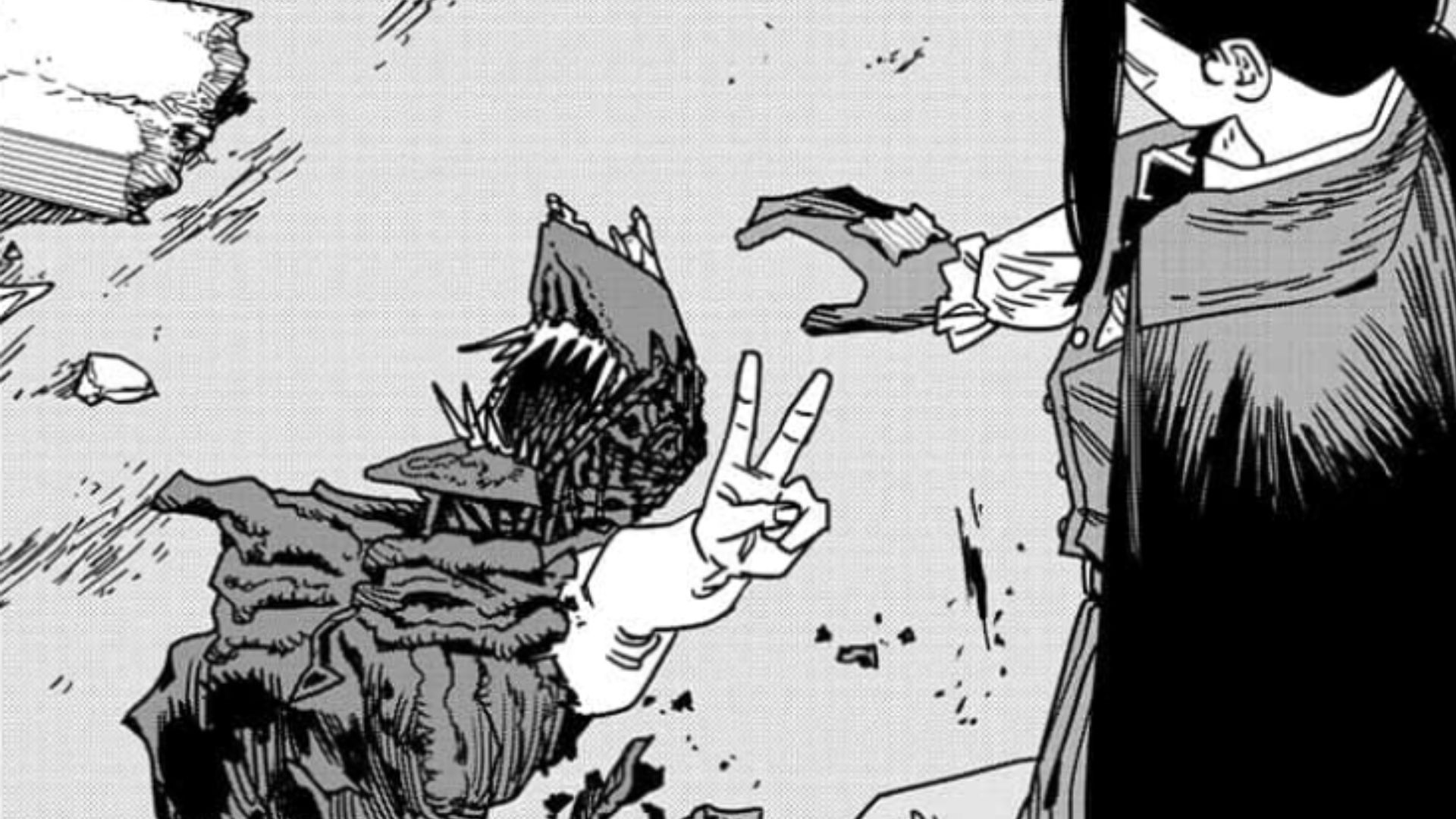
When he took control over Pochita and faced Yoru, the first thing he did before she turned him into a weapon was throw off a supposedly peace sign, which is also interpreted as Scissors (from the rock, paper, scissors game), and he claims that he won this round against her. While the obvious meaning is that he wanted to play a psychological game with her to make her feel like she lost, looking deeper into his moves, it seems like Fujimoto has an important message to give.
For a series that thrives on chaos, violence, and existential dread, that single gesture feels deliberately out of place. The message might be simple; the creator might just want to say that peace defeats war.
After all, Yoru is literally the War Devil. Denji flashing a peace sign after “beating” her seems like Fujimoto making a blunt statement about violence being incapable of ending war itself. But Chainsaw Man has never been that simple, and Denji has never been that noble.
The symbolic meaning: Peace, victory, and absurdity in Chainsaw Man

Symbolically, however, the particular panel of Denji throwing this alleged peace sign in Chainsaw Man still carries weight. Denji does not punch, tear, or consume Yoru. Instead, he wins without escalating the violence further. The peace sign functions as both a victory pose and a thematic statement, peace over war, loopholes over brute force, absurdity over escalation.
What makes this work is that Fujimoto never forces one interpretation over the other. The scene can be read as clever power-system exploitation and as a symbolic defeat of war by peace. The ambiguity is intentional. Meaning in Chainsaw Man is always shaped by context, not authorial lectures.
Fujimoto’s bigger point without a moral lecture

Because this is a small moment that might be even overlooked is in fact what makes this moment so effective. Fujimoto has ensured that he is not delivering a grand speech or an intense moment that talks about how non-violence is the way to go. Rather, in a small panel, he showed his views on how peace would solve everything.
Instead, he shows how violence perpetuates itself, especially when dealing with concepts like war that cannot be erased through force alone. There is also a strong character reading here. Denji’s journey mirrors a kind of transformation, from burden to rage, to something closer to childlike freedom.
In this moment, Denji isn’t trying to be a hero, a weapon, or a symbol. He is having fun. He has figured out how to win, not in a cosmic sense, but in a way that matters to him right now.
 Trending
Final thoughts
In conclusion, Denji might subconsciously be doing things that he is not even able to comprehend properly. So, while it could be a peace sign or scissors sign, it was undeniably effective. That’s the genius of Chainsaw Man: A story where a goofy hand gesture can represent victory, survival, love, and the quiet realization that sometimes, the smartest way to fight war is not to fight it at all.


 Reply
Reply


