


'%20x='0'%20y='0'%20height='100%25'%20width='100%25'%20%0A%20%20%20%20%20%20%20%20%20%20xlink%3Ahref='data:image/jpg;base64,/9j/2wBDAAYEBQYFBAYGBQYHBwYIChAKCgkJChQODwwQFxQYGBcUFhYaHSUfGhsjHBYWICwgIyYnKSopGR8tMC0oMCUoKSj/2wBDAQcHBwoIChMKChMoGhYaKCgoKCgoKCgoKCgoKCgoKCgoKCgoKCgoKCgoKCgoKCgoKCgoKCgoKCgoKCgoKCgoKCj/wAARCAAGAAoDASIAAhEBAxEB/8QAFQABAQAAAAAAAAAAAAAAAAAAAAb/xAAhEAACAQMEAwEAAAAAAAAAAAABAwIABBEGEiExFEFRUv/EABQBAQAAAAAAAAAAAAAAAAAAAAD/xAAUEQEAAAAAAAAAAAAAAAAAAAAA/9oADAMBAAIRAxEAPwC5krzdRWzIXD0IWGmEIEfknMgc7jke/tVqdSKCViVjbSltGSUjnjvulKD/2Q=='%3E%3C/image%3E%3C/svg%3E)

Chainsaw Man has never been afraid to take its ideas to the surreal and disturbing extremes, and the events of the second half of Part 2 with Yoru are a testament to the boldness of that creative spirit. As the manga pushes its stakes to greater extremes, Tatsuki Fujimoto incorporates political allegory, cosmic visuals, and devil mythology into scenes that suggest both shock and interpretation.
Chapter 223 is a turning point, and it may be discussed seriously about the extent of the powers of the War Devil.
The implication of Chapter 223 is clear, and it is plain that Yoru is making the Moon a weapon or is at least attempting to do so. The last pages of the chapter show the cracks that are visible on the surface of the Moon being created in lapse time, purposely placed under an American flag.
This imagery aligns directly with Yoru’s established powers and provides a clear narrative signal rather than a vague metaphor.
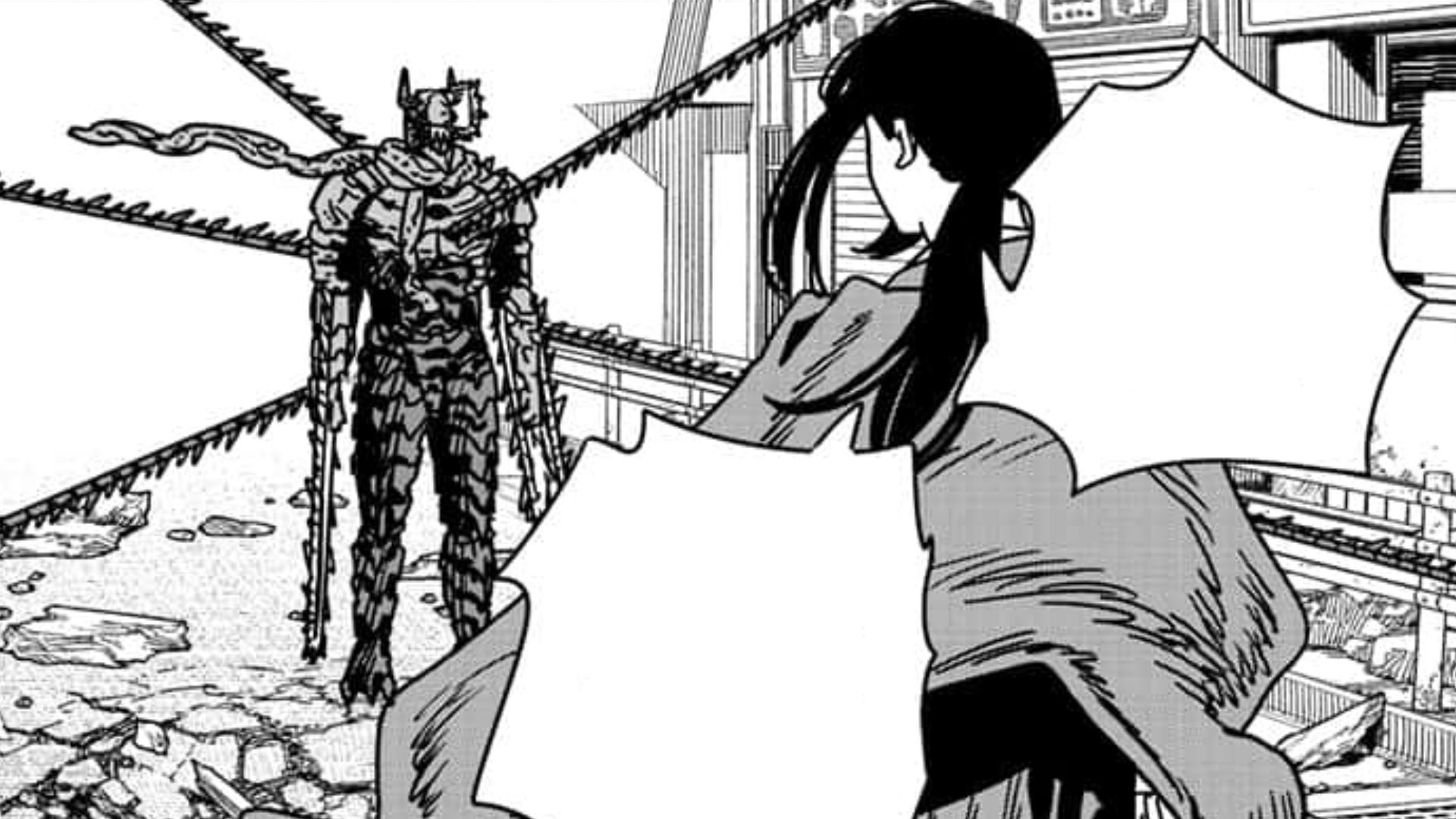
To understand why this moment matters, it is important to revisit Yoru’s role within Chainsaw Man. As the War Devil, Yoru’s power is rooted in ownership, conflict, and human history tied to violence and conquest. Throughout Part 2, Yoru has demonstrated the ability to transform objects into weapons if they are perceived as belonging to her through war-related logic. This has included everything from school property to national symbols, provided she can justify possession.
The Moon’s sudden prominence in chapter 223 is not arbitrary within Chainsaw Man. Fujimoto has made multiple efforts to express abstract power through large-scale imagery, including the doors to Hell, primordial evil, and even post-apocalypse landscapes.
The Moon, which was long a symbol of the most significant geopolitical rivalry in the history of humanity, the Cold War, has a natural touch of conquest, nationalism, and military rivalry. These themes fall exactly within the conceptual area of Yoru.

This relationship is also supported graphically in chapter 223, where the author discusses the American flag planted on the Moon, which is an obvious allusion to the Apollo missions. Within the logic of Chainsaw Man, this symbol is crucial. Yoru’s power does not require legal ownership but psychological and ideological possession. By framing the Moon as American territory due to that flag, the narrative provides Yoru with the justification needed to claim it as a weapon.
The absence of immediate destruction in chapter 223 is also significant in Chainsaw Man. Rather than showing the Moon being hurled or reshaped outright, Fujimoto focuses on cracks spreading across its surface. This restraint suggests intent rather than completion, positioning the act as an imminent escalation rather than a resolved event. The visual language mirrors previous instances where Yoru prepared a weapon before unleashing it.
From a thematic standpoint, this development fits squarely within Chainsaw Man’s critique of power and ambition. Yoru turning the Moon into a weapon represents the ultimate expression of war ideology: converting humanity’s greatest scientific achievement into an instrument of destruction. The Moon, often symbolizing hope, exploration, and unity, becomes corrupted by the same logic that fuels endless conflict.
Narratively, this moment also raises the scale of the conflict beyond anything previously seen in Chainsaw Man. While devils have threatened cities and nations before, the Moon’s weaponization implies planetary or even global consequences. This shift reinforces the idea that the War Devil’s return signals not just personal tragedy but existential danger.
Chainsaw Man and the Moon Weapon Theory Explained
The mechanics behind Yoru’s action are consistent with her prior weaponizations. In earlier chapters, she transformed objects by asserting emotional or symbolic ownership, often tied to guilt, sacrifice, or national identity. The Moon’s transformation follows the same internal logic, with the American flag acting as the catalyst rather than a contradiction.
The cracks shown in chapter 223 are therefore not symbolic flourishes but visual confirmation of an active transformation.
Importantly, Chainsaw Man does not yet show the Moon fully converted into a specific weapon form. Whether it becomes a projectile, blade, or gravitational tool remains unrevealed. Nevertheless, the exposition of the story in chapter 223 does not lend itself to any other interpretation, since the visuals are the same that were used in the previous scenes of weaponry manufacturing with Yoru.

This scene also supports the narration style of Fujimoto to Chainsaw Man, whereby there is absurdity and coherence. The fact that the Moon is turned into a weapon is an overstatement but the manga carefully anchors it in earlier rules. The result is escalation without contradiction, a hallmark of the series’ structure.
 Trending
In conclusion, Chainsaw Man chapter 223 makes it clear that Yoru has effectively claimed the Moon as a weapon, using its association with American conquest to justify ownership. Although the final form of the weapon is still not deployed, the visual and narrative evidence point to this interpretation with a high level of accuracy. The chapter is the final point of the rapid increase in the level of power and the importance of the themes that support Yoru as one of the most threatening powers in the series.


 Reply
Reply


