


'%20x='0'%20y='0'%20height='100%25'%20width='100%25'%20%0A%20%20%20%20%20%20%20%20%20%20xlink%3Ahref='data:image/jpg;base64,/9j/2wBDAAYEBQYFBAYGBQYHBwYIChAKCgkJChQODwwQFxQYGBcUFhYaHSUfGhsjHBYWICwgIyYnKSopGR8tMC0oMCUoKSj/2wBDAQcHBwoIChMKChMoGhYaKCgoKCgoKCgoKCgoKCgoKCgoKCgoKCgoKCgoKCgoKCgoKCgoKCgoKCgoKCgoKCgoKCj/wAARCAAGAAoDASIAAhEBAxEB/8QAFgABAQEAAAAAAAAAAAAAAAAAAAYH/8QAIhAAAQQBAgcAAAAAAAAAAAAAAQIDBBEABSEGEhMUUWGB/8QAFAEBAAAAAAAAAAAAAAAAAAAAA//EABkRAQADAQEAAAAAAAAAAAAAAAEAAxECIf/aAAwDAQACEQMRAD8Ax+FxJFZfCC0/s2orWQlRIVy0BuKq7se/lRF0J2VFZkd4sdVAcok7WL84xg3AcmRqvV2f/9k='%3E%3C/image%3E%3C/svg%3E)

It is true that sitcom storytelling often relies on structure, but the evolution of the characters is what makes relationships unforgettable! The basic plots of all sitcoms with their well-defined relationships determine the mood and the humor.
Some relationships slowly change the dynamics of the audience experience of the show. They are the pairs who began as opposites or merely functional groups and have grown to be something of much more importance in the future.
Now, here is where the sitcom gets its power! Not by sudden shocks, but by a calm and steady process. These pairings were not ignored or unplanned; they were planted early on, then nurtured as the acting, writing, and audience response showed more and more potential.
Here are 7 sitcom duos we never thought we needed (until we did)
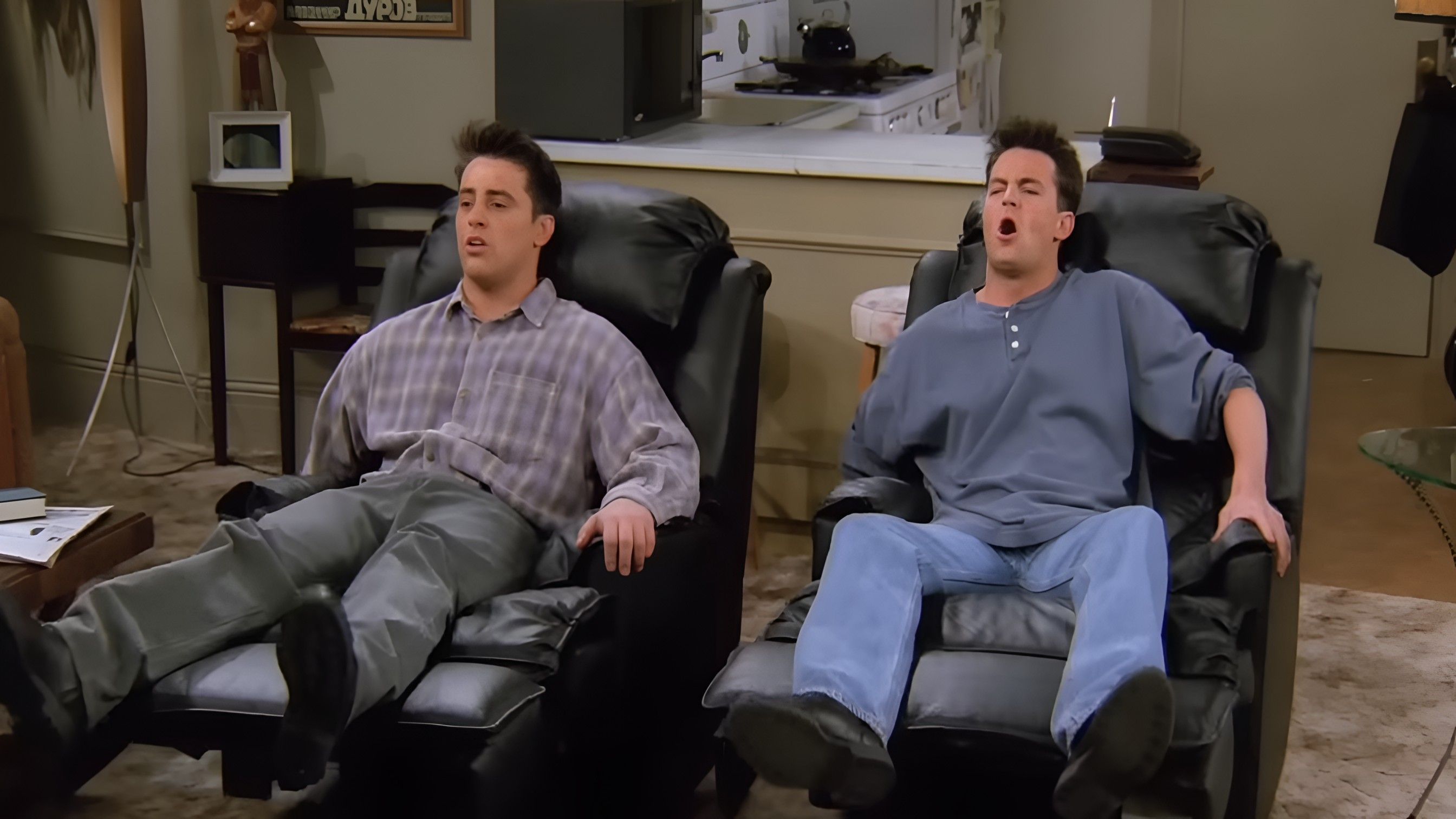
1. Chandler Bing and Joey Tribbiani in Friends
The structure of Friends was set up for romance and group interactions instead of single friendships when the show started. Chandler Bing and Joey Tribbiani simply started off as roommates. Chandler's sarcasm and Joey's simplicity came together to create quick humor.
Their friendship transformed into one of the most dependable emotional constants of the sitcom by the second season. The frequency with which the romantic relationships changed was overshadowed by the unchangeable friendship of Chandler and Joey.
The network planned that their dynamic would be brought about and maintained gradually through support of comedy and loyalty and show friendship grounded in no melodramatic ascensions. Their companionship was not inevitable through predetermined circumstances, but rather because of their unwavering nature.
2. Leslie Knope and Ron Swanson in Parks and Recreation

Parks and Recreation chose to display Leslie Knope and Ron Swanson as ideological opposites right from the start and continued doing so throughout the series. Their contrasting opinions on the nature of government and passion for work were the basis of the sitcom's workplace conflict and political jokes.
What emerged was not an agreement but a kind of trust. The sitcom allowed their mutual respect to grow without the necessity of any ideological change. Leslie looked up to Ron for his honesty, while Ron thought of Leslie as a very committed person.
Their relationship became important emotionally, as it clearly showed that long-term respect can exist without resolution, something that is infrequent but very effective in sitcom storytelling.
3. Schmidt and Nick Miller in New Girl
In New Girl, Schmidt and Nick Miller were characterized initially as sources of friction rather than emotional bonding. Schmidt's ambition and preoccupation with his appearance were in conflict with Nick's conflict-averse ways, and the resulting humor was based on their differences.
As the sitcom matured, their relationship transformed into a continuous reflection on friendship and adulthood. Schmidt was always pushing Nick to take life more seriously, and Nick was able to support Schmidt in his times of doubt.
Their partnership was not significant because it was not expected; on the contrary, it was significant because the sitcom allowed it to grow from being a surface of jokes into a long-term emotional thread.
4. Michael Scott and Dwight Schrute in The Office (U.S.)

It was in the very first episode of The Office that Michael Scott and Dwight Schrute got to play out an exaggerated boss and employee scenario. The disloyalty of the office staff and the person in charge's need for praise were unrealistically heightened for the whole aspect of humor to be clear, making their relationship very visible from day one.
The only thing that changed with the passing of time was the depth. The sitcom let the viewers see how the three different things, such as admiration, dependence, and authority, played out and grew among the characters in rather complex ways. Michael’s dependence on Dwight was very noticeable in the end, while Dwight’s faithfulness was also easily visible.
Their relationship became unforgettable, not because it was silent, but because the sitcom permitted it to develop without softening the unpleasantness of its characters.
5. Jake Peralta and Captain Raymond Holt in Brooklyn Nine-Nine

Jake Peralta and Captain Raymond Holt were clearly the main characters around whom Brooklyn Nine-Nine was built. The hot-headed cop and the cold-shoulder captain created a typical sitcom contrast that established the show’s early mood.
The change was in more emotional depth. At the end, their friendship had turned into a mentor–mentee relationship, where trust was the main factor instead of authority. Holt’s control had not changed, and Jake’s excitement had not died either.
Instead, the comedy allowed their relationship to grow naturally, which changed a common trope into a significant long-term partnership.
6. Penny and Sheldon Cooper in The Big Bang Theory

Penny and Sheldon Cooper were portrayed in The Big Bang Theory as socially incompatible people whose dialogues, rather than highlighting compatibility, mainly pointed out the misunderstandings. Their pairing at the beginning worked as a counterbalance to Leonard and Penny’s romantic plotline.
The sitcom did not push this dynamic aside but rather made it a permanent feature. Penny got accustomed to Sheldon’s strict timings, whereas Sheldon slowly but surely accepted Penny’s viewpoint without going through a dramatic change.
Their bond turned out to be one of the most remarkable non-romantic partnerships of the sitcom, showing how contrast could support storytelling over a long period.
7. David Rose and Stevie Budd in Schitt’s Creek
On the contrary, David Rose and Stevie Budd in Schitt’s Creek were never presented as a typical sitcom couple. Their exchanges were very subtle, not rarely being the significant plot elements.
The sitcom allowed their friendship to become strong through a creative restraint rather than an exaggeration of feelings. David’s openness was the opposite of Stevie’s quietness, which gave rise to moments that were characterized by a silent understanding.
Their bond became important not because of flamboyance, but because of their muted presence, illustrating that a sitcom can create deep characters even without following the usual pattern.
Throughout the years in the sitcom genre, the most famous pairs are usually the characters that evolve the most. The relationships started as functional parts of the plot by contrasts, supports, or laughter tools and developed into emotional anchors with the help of careful writing.
One of the signs of a good sitcom is the ability to adapt rather than to redirect. These couples did not replace the main characters but instead increased the emotional scale of their series. By letting characters grow naturally without artificial spotlighting, every sitcom proved the point that long-term storytelling can transform a structure into a substance.
 Trending
Ultimately, these sitcom pairs were not a surprise because they were in the scene, but because of the great significance they gained once they came in.
Also read: Everything we know about the new Star Wars horror tv series


 Reply
Reply


