


'%20x='0'%20y='0'%20height='100%25'%20width='100%25'%20%0A%20%20%20%20%20%20%20%20%20%20xlink%3Ahref='data:image/jpg;base64,/9j/2wBDAAYEBQYFBAYGBQYHBwYIChAKCgkJChQODwwQFxQYGBcUFhYaHSUfGhsjHBYWICwgIyYnKSopGR8tMC0oMCUoKSj/2wBDAQcHBwoIChMKChMoGhYaKCgoKCgoKCgoKCgoKCgoKCgoKCgoKCgoKCgoKCgoKCgoKCgoKCgoKCgoKCgoKCgoKCj/wAARCAAGAAoDASIAAhEBAxEB/8QAFQABAQAAAAAAAAAAAAAAAAAAAAT/xAAhEAACAQMDBQAAAAAAAAAAAAABAgMABBEFFCEjMWFxwf/EABUBAQEAAAAAAAAAAAAAAAAAAAME/8QAGREBAQADAQAAAAAAAAAAAAAAAQIAA1Gx/9oADAMBAAIRAxEAPwC+01AB7i3MS9KPEGABhgTlmPztUs9pO08h3L8sTyfPqlKLYpImUaJmrROeGf/Z'%3E%3C/image%3E%3C/svg%3E)

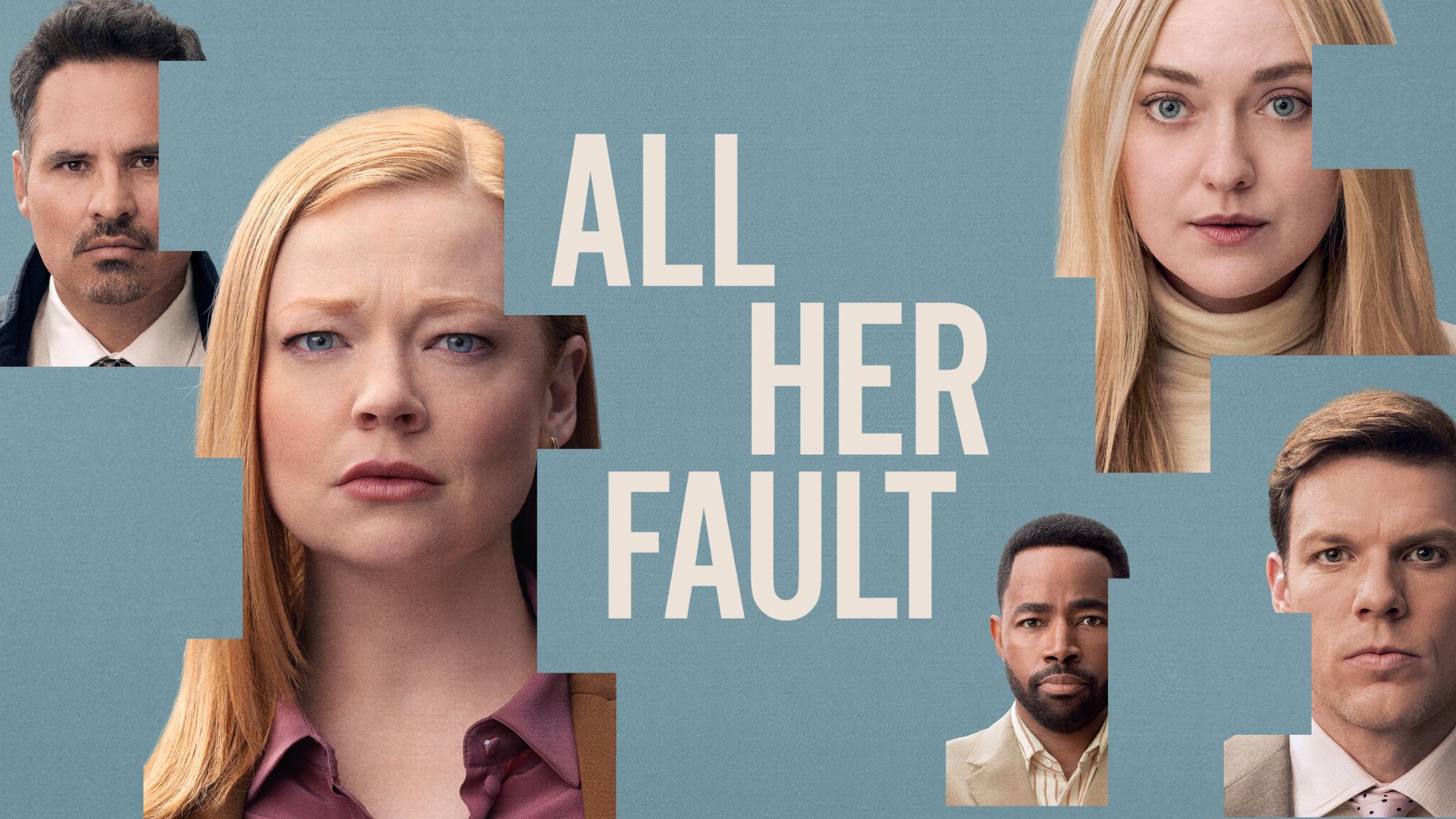
Peacock’s psychological thriller All Her Fault premiered on November 6, 2025. The eight-episode miniseries, adapted from Andrea Mara’s 2021 novel, stars Sarah Snook as Marissa Irvine, a wealthy businesswoman whose five-year-old son, Milo, disappears during what’s supposed to be a simple playdate pickup.
All Her Fault kicks off with Marissa showing up to pick up her son, Milo, after his first playdate. But when she knocks, the woman who opens the door looks confused. She has never heard of Marissa or Milo. And then, Marissa is living every parent’s worst fear. Everything pulls her deep into a web of lies that centers on Carrie Finch, the nanny.
As the search for answers drags on, Marissa’s family starts to unravel. The only real lifeline she finds is Jenny Kaminski, a new friend played by Dakota Fanning.
Disclaimer: The article reflects the writer’s personal opinions. Reader discretion is advised.
Why All Her Fault is television’s most brilliantly ironic title?

I have seen enough thrillers to know when a title is doing a lot of heavy lifting than it might seem to be at first, but in the case of All Her Fault, the element of irony is disclosed after you have gone through the whole trip. The brilliance of this title is that it is ambiguous on purpose. The “her” changes as the series progresses and involves almost all women in the story before ultimately subverting our preconceptions about blame, motherhood, and moral responsibility.
The first thing that came to my mind when I heard the title was that it would be a repetition of the old cliché of motherly guilt, where a mother looks away and never sees her child again, always feeling guilty of her choice to do that. Yet this expectation is gradually shattered in All Her Fault.
The title at first appears to refer to Marissa herself, the working mother who left her son with other people to grow her career as a wealth manager. The show addresses the societal expectations on working mothers, and the first few episodes enable viewers to see how Marissa doubts every decision of hers.
Then the attention turns to Jenny, who employed the nanny who would eventually plan the kidnapping. I was wondering how simply the title can be applied to her: her fault was not to check with Carrie more carefully, her fault was to trust too easily. The series explores the theme of guilt very well, as Jenny gets engulfed by self-blame for bringing this person into her home and subsequently into the world of Milo.
That is where the irony strikes with full force, though: the real name of Carrie is Josephine "Josie" Murphy, and she was pregnant with her own son when she was a teenager, and her baby was killed in a car crash right after they left the hospital. Or so everyone believed.
Through flashbacks, All Her Fault unveils that Josie has led a traumatic life as a neurodivergent teenager with no support system, and was left behind by everyone who was supposed to protect her. When her boyfriend, Kyle, was caught trafficking drugs as he tried to get money to buy a crib for their baby, and when she lost her child in that accident, the title appeared to reverberate the words of her abusive mother and criminal father, who had constantly told her: It was all her fault.
The real irony is summed up in the shocking revelation of the finale. Peter had swapped the infants at the crash site six years ago. Their son was killed in the accident, not Carrie’s, and the child they brought up as Milo was Carrie’s own biological son. This one desperate act of Peter, who in a moment decided to replace infants, when both mothers were unconscious, is the trigger of the whole tragic sequence of events. The title then acquires a new meaning. Is it all Peter’s fault? It is he who made the choice that would afflict several families.
I still find myself returning to that title and using it to wonder at its multi-layered irony. “All Her Fault,” but which “her”? Is it the fault of Carrie to claim back the child that was hers? Is it the fault of Marissa to have found the wrong people to trust, or to have finally settled on murder, rather than truth? And is it Jenny who should be blamed for hiring and paving the way for everything? Is it the fault of Lia, Peter’s sister, to hide important information?
 Trending
The series producer, Megan Gallagher, has created a title that serves as a Rorschach test in itself, uncovering more about our prejudice regarding gender, motherhood, and blame than about any single character’s culpability. It is further ironic when you look at how society allocates blame in situations that involve children. It is the mothers who suffer the wrath of our culture: they are blamed for working too much, for being too protective, for not being protective enough.
The title itself is a lead-up to this anticipation, and I think most audiences started watching All Her Fault expecting to see another story on paternal failure. Rather, the series reveals how this reflexive attribute of blame to women obstructs the more complicated reality.


 Reply
Reply


