


'%20x='0'%20y='0'%20height='100%25'%20width='100%25'%20%0A%20%20%20%20%20%20%20%20%20%20xlink%3Ahref='data:image/jpg;base64,/9j/2wBDAAYEBQYFBAYGBQYHBwYIChAKCgkJChQODwwQFxQYGBcUFhYaHSUfGhsjHBYWICwgIyYnKSopGR8tMC0oMCUoKSj/2wBDAQcHBwoIChMKChMoGhYaKCgoKCgoKCgoKCgoKCgoKCgoKCgoKCgoKCgoKCgoKCgoKCgoKCgoKCgoKCgoKCgoKCj/wAARCAAGAAoDASIAAhEBAxEB/8QAFgABAQEAAAAAAAAAAAAAAAAAAAQH/8QAHxAAAgEEAgMAAAAAAAAAAAAAAQMCAAQFEQYhEmFx/8QAFQEBAQAAAAAAAAAAAAAAAAAABAX/xAAZEQABBQAAAAAAAAAAAAAAAAAAAQIhMUH/2gAMAwEAAhEDEQA/AK+Z8Ax3GLZF+1smxu3ItHJhAeEydQEtbHvffdYRdZTFJuXKTjHFcJmMSbkxJAOh0BofKUqqk3gdp//Z'%3E%3C/image%3E%3C/svg%3E)

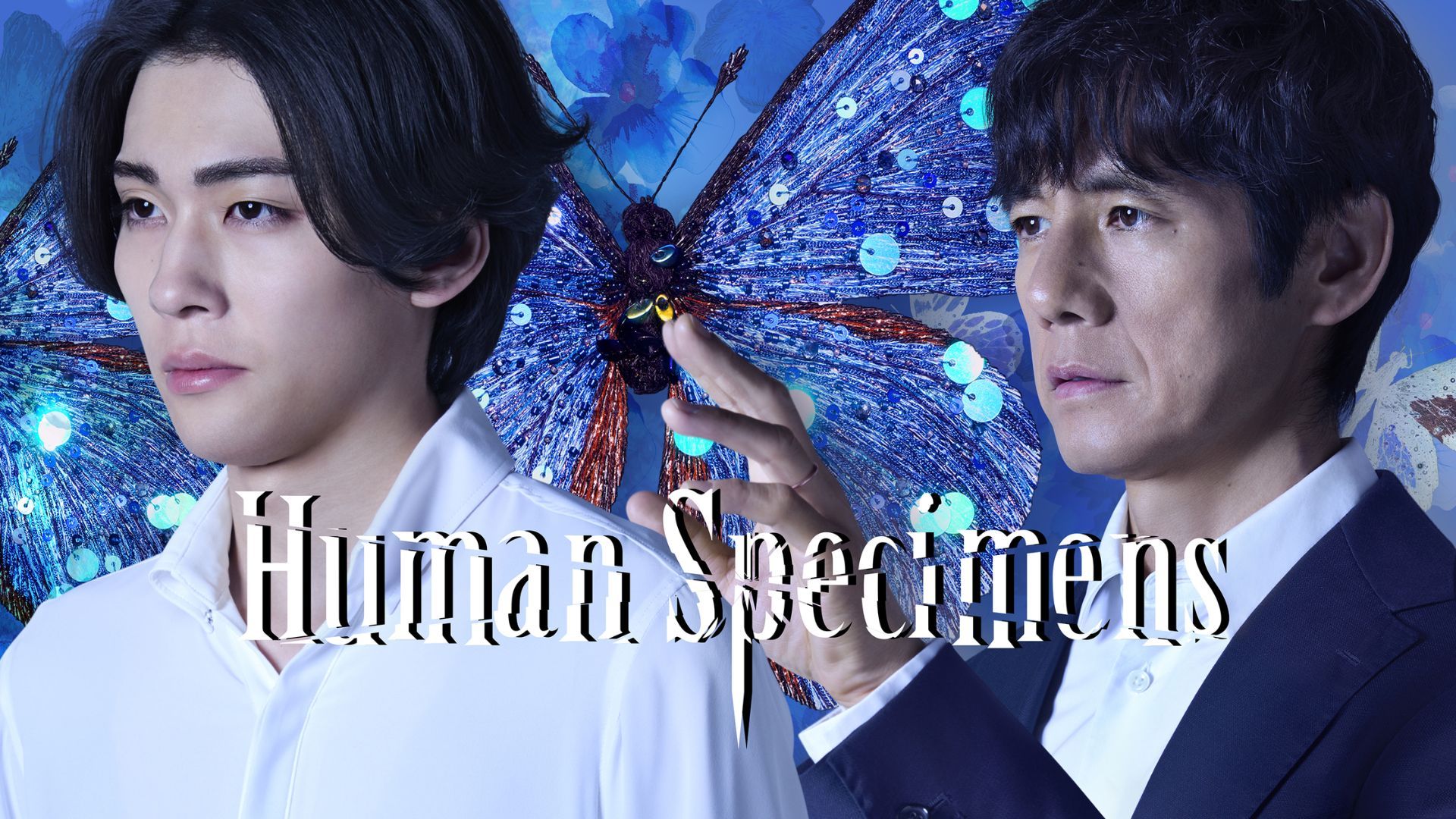
Human Specimens dropped on Prime Video with all five episodes at once on December 18, 2025. The show is ripped from the pages of Kanae Minato’s novel, and Ryūichi Hiroki is behind the camera. It stars Hidetoshi Nishijima in the lead role.
Right from the start, you are hit with a bizarre confession. Professor Shirō Sakaki, who spends his days geeking out over butterflies, strolls into the police station and casually admits to killing six boys, including his own child, Itaru. He turns their bodies into twisted, butterfly-inspired art pieces and puts them in the woods.
The cops start questioning Shirō, but the story doesn’t stick to his side. You get shifting points of view, and every character has their own version of what went down at Rumi’s old, creaky family villa. It’s like everyone is building their own jigsaw puzzle, but none of the pieces quite fit. By the end, you are left with this tangled mess of half-truths, lies, and more secrets than you started with. The truth, like art itself in this series, depends on who is looking and how.
The boys, Ao, Sho, Hikaru, Toru, and Dai, didn’t wander into this. Rumi Ichinose, who is an art world legend because she can see way more colors than regular humans, invites them to this supposed “art competition.” The winner gets to be her successor. Except things go full-on nightmare in Human Specimens before you know it.
Rumi’s art is famous because she sees the world in a trippy, technicolor way no one else can even imagine. But that kind of vision comes with a price, one the boys never saw coming.
Human Specimens ending explained

The series Human Specimens begins with five kids, Ao, Sho, Hikaru, Toru, and Dai, being invited to stay in a refurbished ancestral villa owned by a famous painter, Rumi Ichinose. The concept is very basic at first glance: the boys are told they will compete to become Rumi’s artistic successor.
Rumi is renowned for her tetrachromatic vision, which is a rare condition that enables her to see millions of colors more than an ordinary person. This talent turned her into a legendary figure in the artist community as her creations revealed viewpoints that no one else could see.
Shirō and his son, Itaru, show up too, because Shirō is convinced Rumi is all about giving his son a shot at glory. But this whole competition is a big fat lie. Nobody is walking out as the next art superstar. They didn’t get chosen for their talent; they got picked for something way, way darker.
By the end, it becomes clear that Rumi Ichinose was the puppet master all along. The Human Specimens project was her twisted brainchild. Shirō and her go way back. Turns out, Shirō’s dad was an artist too, but he used real people as “inspiration,” turning them into hyperreal portraits. One canvas featured Rumi’s mom. Grown-ups raved about it, but little Rumi, with her superhuman tetrachromatic vision, spotted flaws nobody else could even imagine.
Shirō, trying to cheer her up, dragged her off to a butterfly garden. She got a sensory overload with colors everywhere, and this scene left a print on Rumi’s brain. Butterflies, colors, the way people see stuff, all that became her jam. Moreover, it became her obsession.
Jump ahead a few years in Human Specimens, and fate does its thing. Rumi’s mother succumbed to a mysterious disease, which now started to ruin Rumi’s tetrachromatic sight. For a painter whose reputation and self-esteem relied solely on that talent, the deprivation was agonizing. On top of that, her child, Anna, was not the fortunate one. This means Rumi would not pass on any artistic inheritance after she dies.
So Rumi, looking at her impending death and obscurity, hatches a plan: the Human Specimens project, her warped magnum opus. In her head, those boys were future-potential artists doomed never to hit it big. So, why not “immortalize” them as literal art? Plus, she would finally give Shirō what he always wanted: to see the world like a butterfly. Except by turning humans into butterfly specimens.
When Rumi’s health started deteriorating, she packed up and flew back to the States, ordering Anna to wrap up the project. Anna had spent her whole life as her mom’s shadow, copying Rumi’s every brushstroke, never figuring out her own vibe. She is always second-guessing herself, stuck with this gnawing sense that she would never measure up, especially since she didn’t have a tetrachromatic vision Rumi flaunted.
But everything flipped when Anna started taking lives.
As she killed those boys and pieced together the installation, something wild happened: her own tetrachromatic vision basically exploded to life. Turns out, all it took was a little blood on her hands. Now she could finally finish the backdrop that Rumi herself had abandoned after going blind. The cruel punchline is that Anna had to become a monster just to be “good enough” for her mother.
And then, before Rumi dies, she twisted the knife one last time. Anna didn’t show Shirō the finished piece, so Rumi refused to name her successor. That rejection left a hole in Anna that would never heal. She is stuck, forever finding a way out of Rumi’s shadow, but never actually breaking free.

In Human Specimens, Itaru was never supposed to be in the installation. Not really. He was a talented photographer, but he always felt stuck in the shadow of his father and grandfather, both of whom were painters. However, Shirō never told him to feel that way, but Itaru carried that ‘not good enough’ baggage anyway. At the villa, he hung around, helped Anna pull off Rumi’s bizarre scheme, but when Anna packed up and went back to the States, Itaru made a choice that wrecked everything.
For the first time, he painted. He paints the world through butterfly eyes, finally nailing the vision Shirō had obsessed over forever. But Itaru can’t just stop there. He decides to put himself as the sixth specimen.
Was that always the plan? Or did he just snap in the moment? That’s not clear. He left behind a trail for Shirō: little clues, notes, and more. He even left a message begging Shirō to make him a specimen, but then painted over it. Shirō shows up, finds the installation, and finishes what Itaru started. Was he doing it because he thought that’s what Itaru wanted, or just unable to process what happened? We don’t get a straight answer from Human Specimens. And maybe that’s the point.
At the end of Human Specimens, Shirō owns up to all six murders. He is not even the worst of the bunch, but he takes the whole blame anyway. He was trying to protect Itaru’s name, make sure his son goes down as a victim, not a psycho killer. He covers for Anna, too, even though she actually killed five boys. And Rumi is the real puppet master here, and she just slips away by dying in her sleep.

Shirō’s move is the biggest heartbreak. Out of everyone, his hands are probably the cleanest, but he is the one who ends up in prison, weighed down by the fact that he had to kill his own kid.
Anna comes by to see him and reveals how Rumi was pulling the strings. You would think Shirō would lose it, but he doesn’t blame Anna at all. Instead, he gets it. She is just collateral damage from her mom’s messed-up obsession. He sticks to his confession, lets Anna walk free.
Human Specimens is a story about what happens when you chase perfection just to get a pat on the back from somebody else. Shirō’s father made art for himself and found his little slice of peace. Shirō figured out that seeing the world through “butterfly eyes” was never really going to happen, and he was cool with that. But Rumi couldn’t handle having limits. Her so-called ‘gift’ blew up into a big mess of ego. Anna killed for love, and Itaru sacrificed himself just trying to matter.
The bitter irony is that the Human Specimens installation achieved nothing. It wound up as evidence, then they tore it down, carted the bodies away, and scrubbed the art from existence. What’s left? Just a big gaping loss.
Butterflies are supposed to be about changing for the better. But here, that whole idea gets twisted: sometimes you don’t get a pretty butterfly. Sometimes you just get a monster.
So what’s the takeaway? If you let art eat you alive, if you care more about your ‘legacy’ than actually living, then beauty turns into something lethal. And everyone ends up paying the bill.
 Trending


 Reply
Reply


