


'%20x='0'%20y='0'%20height='100%25'%20width='100%25'%20%0A%20%20%20%20%20%20%20%20%20%20xlink%3Ahref='data:image/jpg;base64,/9j/2wBDAAYEBQYFBAYGBQYHBwYIChAKCgkJChQODwwQFxQYGBcUFhYaHSUfGhsjHBYWICwgIyYnKSopGR8tMC0oMCUoKSj/2wBDAQcHBwoIChMKChMoGhYaKCgoKCgoKCgoKCgoKCgoKCgoKCgoKCgoKCgoKCgoKCgoKCgoKCgoKCgoKCgoKCgoKCj/wAARCAAGAAoDASIAAhEBAxEB/8QAFgABAQEAAAAAAAAAAAAAAAAAAAQF/8QAJBAAAgEDAgYDAAAAAAAAAAAAAQMCAAQhBREGEhMUFyIjMTL/xAAVAQEBAAAAAAAAAAAAAAAAAAADBP/EABcRAQEBAQAAAAAAAAAAAAAAAAERAAP/2gAMAwEAAhEDEQA/AMbgldzp6tS1W3laQumL7lUWI68VwCiTEc5x+dxjBJqbyG9vyNALJ+0iLZQ3J+8UpQc1bq+gEm//2Q=='%3E%3C/image%3E%3C/svg%3E)

Mad Men, even in its most silent phases, can convey the most shocking experiences, and the birth of Peggy Olson's child is one of them.
While Mad Men, as a show, stands on restraint, ambiguity, and emotional detachment, few episodes come across as hard-hitting as this one.
Accordingly, a question arises in this context: what happens to the baby in Mad Men? Peggy Olson gave birth to a baby boy in Season 1; she gave him up for adoption, which means that she would not be involved in his life or take care of him. The show later proclaims that she never, at any time, gets back to him.
The plotline is continually a subject of fascination for the audience because it is never told in a traditional manner. Mad Men shun large-scale reconnecting, foot-to-the-floor emotional speeches, or ending of the story through character dying or moving away. Rather, adding to her emotional boundaries and life choices without turning into a subplot that reoccurs, Peggy's pregnancy has been a silent fact.
The case of psychological denial in Mad Men: Peggy Olson's pregnancy
Peggy Olson's pregnancy is uncovered in the Season 1 finale when she faints at work and is taken to the hospital. Up to that moment, Peggy looks to be quite unaware of her pregnancy. The series interprets this as pregnancy denial, a psychological condition that is documented and in which the concerned person is not aware of or does not accept the pregnancy.
The show does not make this disclosure a big story. There is no scene setting up the event or providing an explanation. The series utilizes very few signs and depends on audiences to grasp the seriousness of the matter without explicit narration.
The birth scene: Shock without sentiment
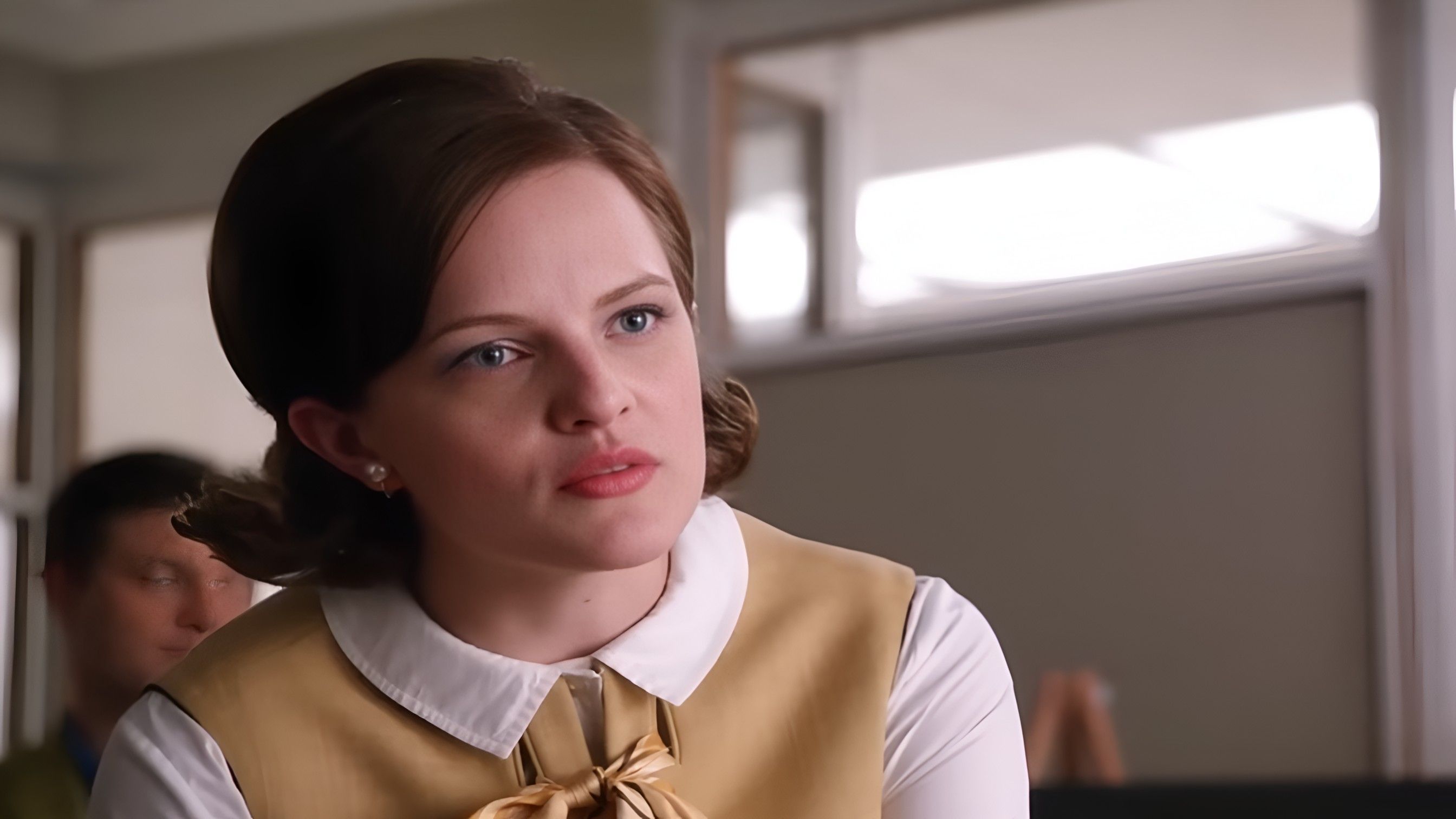
In the hospital, Peggy has a boy. Instead of shaking off the moment with some laughs, like getting a little baby crying or jumping in a panic, her reaction is more like a mixture of confusion and emotional detachment. The birth scene is deliberately subdued, and this serves as the main point in the viewers’ realization of Peggy's mental state, as she keeps her distance from reality.
Although the nurses and doctors clarify the situation, Peggy still finds it hard to understand what is going on. The disconnection of feelings indeed becomes a key point to her later on when she makes her decision.
Adoption narrative and closure
Peggy’s baby is given up for adoption. The show eventually makes it clear that the adoption is not done within Peggy’s close relatives. Peggy does not bring up the kid, stay in touch, or get any updates about his life.
The effects on Peggy's life
The role of the newborn in Peggy's life changes her. Peggy, after the pregnancy, soon becomes more reserved, assertive, and attuned to the development of her career. She is more ambitious, emotionally tougher, and resistance to conventional norms is stronger than ever.
The saga of pregnancy marks silently the line of separation between the person Peggy represented during Season 1's early chapters and the woman she evolves into.
Why Mad Men needed the child to be hidden
The Mad Men series deliberately takes breaks from Peggy's child dealing as a parallel plot. Peggy's baby is not the storyteller's intention to become a character in the unfolding of the main plot.
Instead, the absence of the baby strengthens the identity, sacrifice, and the cost of giving up your dreams as the series' principal themes. What is portrayed is not the story of motherhood; it is the story of choice and consequence.
Fan theories about Peggy's baby's life away from her (speculative and not confirmed by the show)
Mad Men doesn’t give any information about the kid, but the audience has been asking the question for a long time; their curiosity about what happened to Peggy's son is inexhaustible. Such ideas are not part of the official story and are purely the fans' imagination.
Theory 1: A closed adoption with no contact
One theory among the spectators is that the boy was given up for adoption under very strict conditions, so, in effect, neither the birth mother nor the new parents ever knew anything about the other one. This assumption mirrors the prevailing adoption practices of the early 1960s but had no direct support from the series.
Theory 2: A conventional family life
It is very possible that the boy grew up in a very stable middle-class family, completely apart from Peggy’s universe. This view is grounded in the cultural background rather than in the narrative.
Theory 3: The baby as a narrative absence
The baby is a literal presence in the life of Peggy, but some spectators see it as an allegory; the baby is the manifestation of a life that Peggy did not choose to live, rather than a character with a predetermined future. Mad Men doesn't either confirm or deny these theories.
Peggy's emotional distance
Peggy, throughout the show, acknowledged she had a child but did not attempt to have a relationship with him. This separation is shown to be a conscious choice rather than an unresolved emotional wound.
When Peggy refers to her son later in the series, she uses restrained terms. She says he is "with a family somewhere," thus emphasizing her detachment and emotional distance.
Why Peggy's baby rarely appears in Mad Men
Mad Men, unlike many TV dramas, does not constantly bring back Peggy's baby as a conflict or source of emotional payoff. After the first revelation, the child practically disappears from the story.
This absence is purposeful. The baby is a prominent psychological marker instead of being treated as a storyline that keeps ongoing. His presence affects Peggy's cautious character and aspirations, but does not require any acknowledgment.
What really implies the birth of a child in Mad Men
Peggy’s baby, instead, though, was a case of an alternate life choice rather than a conventional character. This part of the script in Mad Men strengthens through the identity, sacrifice, and ambition themes.
The kid is the embodiment of the personal sacrifices that one has to make in order to enjoy professional freedom in a world that offered only a few ways out for women. The kid's absence is not by chance but rather narratively intentional.
Therefore, in Mad Men's Season 1, Peggy Olson gave birth to a boy and put him up for adoption beyond her close family. She does not bring him up, does not have any connection with him, and does not keep any contact with him. The show's outcome here is constant and never goes back over it.
 Trending
As per the storytelling, the plot is not about resolution; it is about consequence. Peggy's child is not erased from memory; he is only living outside the realm of Peggy's chosen life.
Also read: Mad Men: How to watch the period drama online? Streaming details, explored


 Reply
Reply


