


'%20x='0'%20y='0'%20height='100%25'%20width='100%25'%20%0A%20%20%20%20%20%20%20%20%20%20xlink%3Ahref='data:image/jpg;base64,/9j/2wBDAAYEBQYFBAYGBQYHBwYIChAKCgkJChQODwwQFxQYGBcUFhYaHSUfGhsjHBYWICwgIyYnKSopGR8tMC0oMCUoKSj/2wBDAQcHBwoIChMKChMoGhYaKCgoKCgoKCgoKCgoKCgoKCgoKCgoKCgoKCgoKCgoKCgoKCgoKCgoKCgoKCgoKCgoKCj/wAARCAAGAAoDASIAAhEBAxEB/8QAFgABAQEAAAAAAAAAAAAAAAAAAAQH/8QAIRAAAAUEAgMAAAAAAAAAAAAAAQIDBBEABRMhBhQiMVH/xAAVAQEBAAAAAAAAAAAAAAAAAAACA//EABoRAAICAwAAAAAAAAAAAAAAAAECABEDEiL/2gAMAwEAAhEDEQA/AMpsvL2tlXYqNLegooow6zrK3IaRA4mA5RGfLcTr0FRueTlcOFVgaIFyHE8YU9SM/KUoONWoSuHpLM//2Q=='%3E%3C/image%3E%3C/svg%3E)

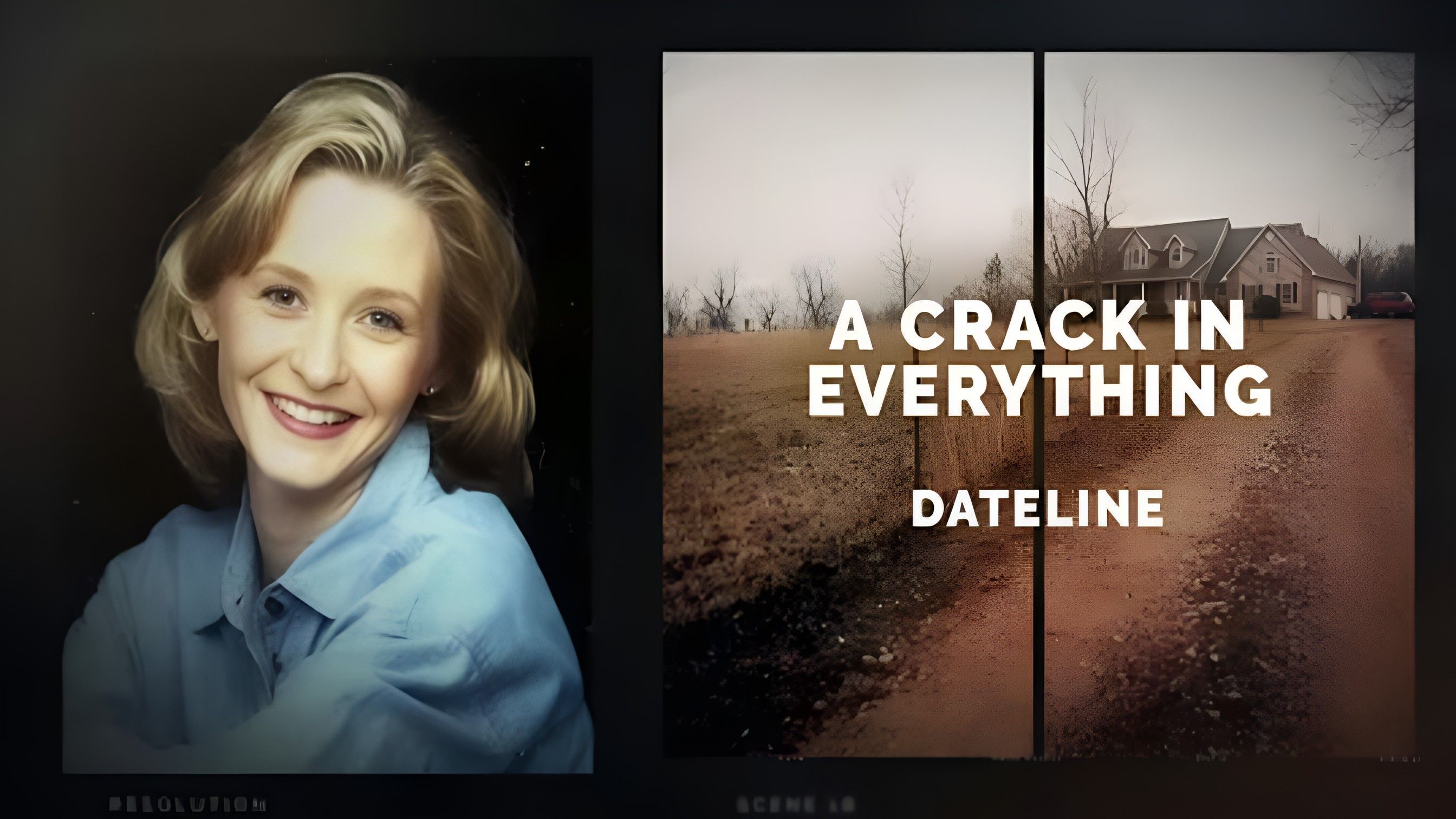
Dateline: A Crack in Everything not only starts off with one of those cases that can only be described as being tragic and simple at the same time, but takes the viewer through an entirely different understanding of the situation!
On Christmas day, a woman lies dead in her home, a gun beside her, and the investigators quickly determine suicide. Dateline, however, exposes how what seems so clear upon initial observation can gradually break down into disturbing doubts and questions that do not fade with time under closer scrutiny.
In Dateline's investigation into the 2006 death of Lisa Jennings, viewers can take part in a case with opposing views, the forensics evolving, and a legal battle that went on for more than ten years. With every new turn of events, the conviction about her death dissipated, revealing the extent of delicacy of the initial assumptions when the new facts contradict the previous story.
Who was Lisa Jennings?
Lisa Jennings was a of 39 year old mother living with her husband, Brad Jennings, in the rural part of Dallas County, Missouri. She was considered to be a very devoted mother and a person engaged with the community. Her life did not give any clue whatsoever that she would find herself, publicly, in the center of a murder case, which later on would be the subject of the national discussion and the Dateline feature.
On December 24, 2006, Lisa was found dead in her house as a result of a gunshot wound to the head. Next to her body, a revolver was found. The tragedy of her death shocked all who knew her.
The initial investigation and suicide ruling
At that time, law enforcement officials were saying the scene's circumstances supported the ruling of suicide. One of the authorities mentioned the firearm around Lisa, and the results of the initial testing of the gunshot showed residue on her hand. No residue was found during testing on Brad Jennings.
The findings led the local sheriff's office and coroner to conclude that Lisa had committed suicide. The case was closed for a short time. Nevertheless, as Dateline later recounted, this conclusion would not be able to stand without being challenged.
Family doubts and a reopened case
Sister of Lisa Jennings was the first among those who doubted the suicide ruling. She voiced her worries that some pieces of the evidence were not in accordance with what she knew about Lisa. Her stubbornness caused a request for a further review and, in the end, the Missouri State Highway Patrol took another look at the case.
The second review was predominantly based on crime scene pictures and forensic evaluations, especially bloodstain evidence. The investigators found some things that they felt did not fit into a simple suicide scenario. These findings resulted in a major change in the authorities' perception of the case, as it was now turned from a closed investigation into an active homicide inquiry.
Dateline and the shift in interpretation
Dateline: A Crack in Everything expertly portrays the clash of this new interpretation with the old one, marking a turning point. The case was no longer about new physical evidence but rather about existing evidence being interpreted in a new way.
Initially, blood patterns and scene dynamics were viewed by the investigators as raising doubts substantial enough to justify a criminal charge. This change in viewpoint is one of the major aspects of the Dateline concept - how the outcome can be different when the evidence is viewed from a different angle.
Arrest and criminal charges
In 2009, nearly three years after the death of Lisa, the suspect Brad Jennings was in jail for murder in the second degree and for armed criminal action. According to the prosecution, when the matter was viewed from a different angle, the forensic evidence revealed that the death of Lisa was not a case of self-killing.
In the course of rehearing, government witnesses were introduced to interpret blood stain pattern analysis, gunshot residue, and so forth. According to them, the points raised were in conflict with those of the suicide ruling. On the other hand, points raised by the defendant touched on how these points were interpreted in the previous case.
Conviction and sentencing
In the year 2009, the jury declared that the defendant, Brad Jennings, is indeed guilty of the two charges. For this reason, the latter was given a twenty-five-year prison term. The outcome of the trial is a sudden turn of events in the case, which started as a suicide incident to a murder, with a tragic result for all the involved individuals.
Dateline later reported that the reason for the adoption of this strategy was mainly in relation to the evidence produced by the forensic expert, to the point that none of the witnesses or any evidence linking the shooting to Brad had come forth.
Critical evidence and legal challenges
This finding led to a series of legal battles, in which a relevant piece of evidence came to the fore. The gunshot residue test, which had been conducted on the robe worn by Brad Jennings on the night of Lisa's death, had yielded a negative result. This piece of evidence had not been presented to the trial in the previous case.
The failure to disclose this evidence became the prominent question during attempts to overturn the conviction. Counsel for the defense argued that the jury's understanding of whether Brad pulled the trigger would have differed if the test had been presented to them.
Vacated conviction and dismissal of charges
2018 marked a year in which a judge overturned Brad Jennings' conviction due to a lack of evidence from the prosecution that could have cleared his name. He spent a few years in jail before being free.
Moreover, in the same year, the case was dropped by the prosecutors since they could not proceed with the retrial due to the matters still outstanding regarding the evidence. It is pertinent to state that this case dismissal did not result in another legal ruling on how Lisa Jennings died.
What remains unresolved
But the story of Lisa Jennings, as reported by Dateline, never ended. Different verdicts came up, and in some instances, one verdict clashed with others. The first verdict was that it was a case of suicide, and this resulted in murder trials. However, no one was ever sentenced.
The level of competition that existed among the various interpretations of the same set of evidence in the first two stages was too great for the courts to withstand. Thus, a final determination in either suicide or homicide was never made. This is a case that serves as a timely reminder about uncertainties that can exist even after a long period of investigation and legal battles.
Why Dateline revisits this case
Dateline: A Crack in Everything explores not only the case of death but also how the process of investigation, forensic findings, and legal judgments shift with new information being brought to light.
For the community at large, the implications are those of justice not necessarily being the same path, and also the realization that conclusions, even after a considerably long time, can have their components disintegrating upon closer scrutiny.
The case of Lisa Jennings remains the subject of the discussion concerning the methods of collecting and processing the evidence, the role of the prosecutor, and the capabilities of the forensic evidence. Dateline takes the entire case without providing a definite truth, thus leaving the audience with the same questions the detectives had to respond to.
 Trending
In the end, Dateline provides its audience with an unvarnished truth: the truth can often remain elusive even after a long period of investigation, and the seams of uncertainty can never quite be fully repaired.


 Reply
Reply


