


'%20x='0'%20y='0'%20height='100%25'%20width='100%25'%20%0A%20%20%20%20%20%20%20%20%20%20xlink%3Ahref='data:image/jpg;base64,/9j/2wBDAAYEBQYFBAYGBQYHBwYIChAKCgkJChQODwwQFxQYGBcUFhYaHSUfGhsjHBYWICwgIyYnKSopGR8tMC0oMCUoKSj/2wBDAQcHBwoIChMKChMoGhYaKCgoKCgoKCgoKCgoKCgoKCgoKCgoKCgoKCgoKCgoKCgoKCgoKCgoKCgoKCgoKCgoKCj/wAARCAAGAAoDASIAAhEBAxEB/8QAFgABAQEAAAAAAAAAAAAAAAAAAAUH/8QAIRAAAAYABwEAAAAAAAAAAAAAAAECAwQREhMhIiMxkuH/xAAUAQEAAAAAAAAAAAAAAAAAAAAE/8QAFxEAAwEAAAAAAAAAAAAAAAAAAAECA//aAAwDAQACEQMRAD8AwRifDbcWpyJiykUnWtxn2KhS41FxH5+gAHpKFxTP/9k='%3E%3C/image%3E%3C/svg%3E)

The first line of the Season 1 finale of Spartacus: House of Ashur reveals the show’s intention very clearly; it is not aiming at ending anything! The series does not give any answer but concludes with a scene that is very carefully planned and openly intended to shake the audience's peace of mind and to generate more buzz around the next episodes.
In this case, the lack of closure is very clear, and it is not a mistake. Rather, the creators of the show have been quite candid regarding the feeling of incompleteness as they consider it to be an integral part of the experience!
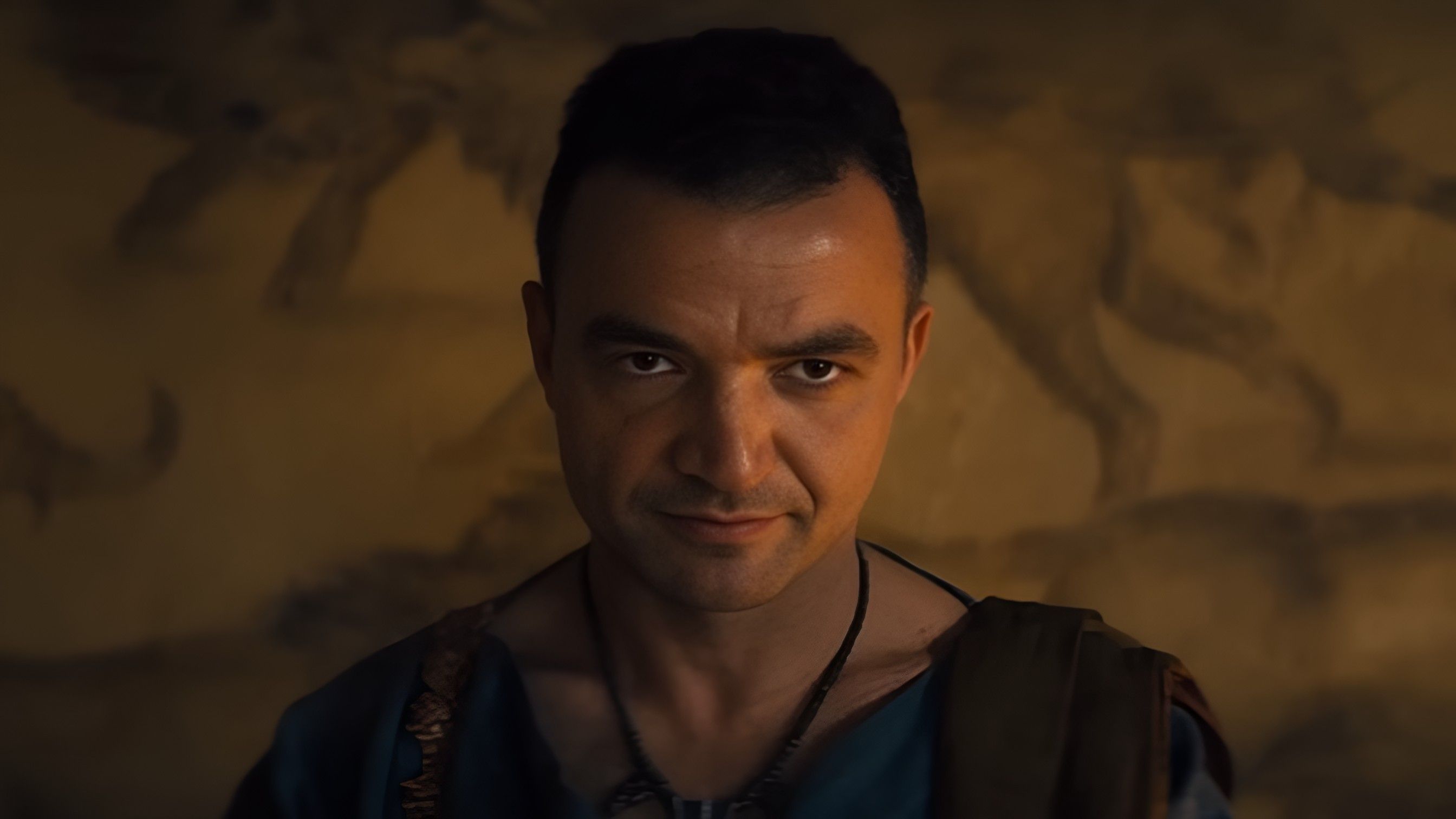
Spartacus: House of Ashur has delivered only the first season so far, and the last episode was made intentionally as a cliffhanger. The lead actor, Nick E. Tarabay, reveals that the final line of Season 1 exists to make the audience cry for Season 2 and not to provide them with emotional and narrative finality.
The ending is a Spartacus: House of Ashur Season 1 cliffhanger, not a series conclusion
One of the most significant points surrounding Spartacus: House of Ashur is that its ending does not mean the end of the series. The finale only marks the end of Season 1. Neither Starz nor the creative team of the show has presented it as a conclusive ending.
The episode ends with unresolved tension because it is meant to be like that. The story stops at a point where it could move forward, indicating that the narrative is still there. This perspective corresponds directly with what Nick E. Tarabay has said, as he has affirmed that the last moments were written to evoke expectation rather than to grant closure.
The final line is designed to create anticipation
The final line of Spartacus: House of Ashur Season 1 does not reduce the season to a summary or dwell on its events. Rather, it casts a gaze towards the future. The aim is to make viewers feel uneasy and be inquisitive about what is coming next.
As per ScreenRant, the line was purposely created to induce conversation and to draw attention to different possibilities. The dialogue does not clarify Ashur's role or the power struggles around him, but rather underlines that the narrative has just turned a corner. This is a classic cliffhanger technique, employed to keep the audience hooked between seasons.
Ashur’s story remains open because the narrative is continuing
Ashur’s arc in Spartacus: House of Ashur is left incomplete at the close of Season 1. His motivations, alliances, and ambitions are still in play. This open ending is not a drawback in storytelling but rather a sign of the show’s never-ending design.
The entire premise of Spartacus: House of Ashur is based on Ashur's survival and his climb up the ladder in a different timeline. If his story were wrapped up too soon, it would greatly limit the future story possibilities. Instead, Season 1 sets him at a point of change, thus reiterating that his saga is nowhere close to being over.
The unresolved ending serves franchise continuity
The Spartacus franchise has always been one that went for long-form storytelling, focusing on the power struggles and alliances that changed over time. The new series, Spartacus: House of Ashur, is no different in this respect, and it first takes time to lay a groundwork for the story before coming to a possible resolution.
By keeping the multiple storylines open in the last episode of Season 1, the narrative gives the upcoming seasons a chance to look into the protagonists' consequences instead of jumping back to the beginning of the story. The narrative strategy here is that it is better to give continuity and expansion than quick closure in a short time.
Why the ending feels unsatisfying to some viewers
A great number of viewers have the habit of looking for at least a partial resolution to the storyline in season finales. Spartacus: House of Ashur made it a point to avoid the situation intentionally. The last episode goes on and does not stop to contemplate; rather, it moves forward with an even faster pace towards what is coming next.
This particular decision of structure has the capacity to create frustration, especially for the viewers who are looking for emotional payoff. Still, the discomfort is due to a misjudgment of the expectation rather than of the narrative consistency. The series offers the same thing that it states it will provide: expectation.
The ending is strategic, not ambiguous
It is necessary to make a choice between ambiguity and postponement. The Season 1 finale of Spartacus: House of Ashur does not leave events open to interpretation; it, rather, postpones resolution deliberately.
The unresolved elements are bold and intentional. The show gives a hint that answers are on the way, rather than indicating that the story is to end in uncertainty.
Why this is not a rejection of closure
Characterizing the ending of Spartacus: House of Ashur as a rejection of closure could be a misleading description, especially if one considers the whole series as one. The show does not deny closure completely; it only stretches it out.
The plot is still inexperienced because it is still ongoing. The Season 1 finale acts as a midpoint rather than an endpoint, thus ensuring that the future events carry narrative weight.
Spartacus: House of Ashur does not provide closure at the end of Season 1 because it was never meant to end. The finale is an intentional cliffhanger, supported by actors' comments and the way the story is told.
The boldest last line, Ashur's character not being finished yet, and the lack of a conclusion all have the same goal: to prepare for more to come. The plot does not close up; it merely takes a break.
 Trending
And that break is precisely where the audience is meant to be when the show is over.
Also read: Spartacus cast: Where have you seen the stars of the OG historical drama before? Details explored


 Reply
Reply


