




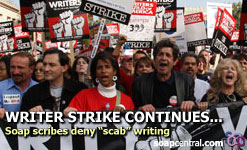
The Writers Guild of America (WGA) and the Alliance of Motion Picture and Television Producers (AMPTP) have been unable to come to terms on a new contract. As a result, members of the WGA have called a strike and hit the picket lines. Many actors, which have their own union, the Screen Actors Guild, are walking the lines with their union brethren. The process has brought taping of some shows to a halt. And with the writers on strike, no new scripts are being produced for television. It doesn't take long to understand that without scripts, there can be no scripted television series.
| THE WRITERS' STRIKE |
|---|
|
Soap fans around the globe counted on soapcentral.com to cover the Writers Guild of America's strike and its impact on daytime television. Here is archived coverage of our news coverage of the strike.
STRIKE ENDS THE ISSUES REACTION THE IMPACT |
There are two key sticking points in the negotiation process. The first point - and arguably the most important one - focuses on how writers are paid for the redistribution of their work on the Internet. Currently, writers are not paid when their work is used on the Internet or sold on an online service such as Apple's iTunes. The Guild was also looking to double the royalties writers receive when their shows are sold on DVD, but WGA withdrew that request to focus on other issues that it deemed more important.
For its part, the AMPTP has refused to boost the DVD residuals, asserting that the studios and networks need those revenues to cover escalating production losses. That same argument is made in regards to broadcasting episodes on the Internet. Networks argue that broadcasting episodes on the web are a promotional tool to help drive viewer eyeballs to their television broadcasts and sponsors' products.
Many writers rely on residuals during times when they are not actively writing on a show. Residuals are royalty fees paid to the writers when, for example, one of their shows is aired in reruns.
The first casualty of the writers' strike has been late-night talk shows, programs that include "The Tonight Show with Jay Leno" and "The Late Show with David Letterman." The nighttime talk shows use writers for the opening monologues and skits that are often performed during the shows. Many of the late shows are already dark, with several shows informing staffers that they will be laid off if the strike drags on past two weeks. These shows could, however, go on as usual without the writers by simply scrapping the scripted portions of the show and allowing the hosts to offer personal commentary on the day's events. For their part, however, both Leno and Letterman have backed the WGA and stopped production on their shows.
Meanwhile, primetime television, which was expected to last well into the new year without feeling any repercussions of the strike, is also beginning to feel the pinch of the strike. CBS's sitcom "The New Adventures of Old Christine," FOX's "Back To You" and "'Til Death" and NBC's "The Office" have already shut down production. ABC's primetime soap "Desperate Housewives" taped its final scripted episode in early November before going dark until the strike is resolved. Other shows are expected to follow suit within the next few weeks. Primetime is expected to turn to reality shows in the event of drawn-out strike. Reality programming is relatively inexpensive to produce and requires no scripts. CBS has already moved forward its production schedule on a new season of "Big Brother."
Daytime dramas are in an unusual position. Soaps typically film episodes about a month in advance of their airdates. Scripts are also written well in advance in order to keep up with the rigors of having to put out a new show five times each week. Primetime shows may only put out 23 episodes each season. This schedule has allowed many soaps to stockpile enough scripts to last through the end of the year, but after that time it's unclear what will happen.
During the last strike by the WGA in 1988 the soaps plugged on even as the prolonged strike lasted 22 weeks and cost the industry $500 million. The various networks hired non-union writers to fill in for the striking WGA members. While new shows were produced, the inexperienced writers were hard-pressed to come up with the same quality of episodes with which viewers had become familiar. Plots dragged on for weeks without resolve and many shows were left in a state of total disrepair.
Obviously, this is not what daytime needs right now. Ratings for many soaps are at or near all-time lows and viewers seem to be tuning out in record numbers. How networks would handle their weekday programming without original episodes of the soaps this time around remains to be seen.
"Passions will be relatively unaffected by the writers' strike. We already have scripts through February and we've already shot our scenes through the New Year," a Passions spokesperson explained.
A spokesperson for Days of our Lives, NBC's only soap, also hints that things are very much the status quo for the moment.
"At this point, we have scripts that will take us into the new year, so we don't expect any immediate interruption with Days of our Lives," a spokesperson tells Soap Central.
NBC has just one hour of scripted drama during its daytime line up. Its network rivals have substantially more invested in the soaps. ABC has three hours of scripted drama and CBS has three-and-half hours of scripted drama each weekday.
"ABC's daytime dramas are written well into the new year, and we will continue to produce original programming with no repeats and without interruption," a network spokesperson said in a statement.
Calls for comment from CBS executives were not returned.
Several soap opera writers have informed the WGA that they plan to go back to work on their shows, perhaps in an attempt to save their jobs. These writers will take was is called "financial core," a move that gives up their full membership in the guild and withholds the union dues spent on political activities in order to continue writing during the strike.
There are also reports of several writers working on various soaps in super secret capacity. A report in Variety claimed that several writers for The Young and the Restless had decided to write for the show even as their colleagues walked the picket lines. The article so incensed the show's writers that they released a statement.
"Our entire writing staff of 18 is united and we fully support our union. Not a single person who was writing for Y&R when we struck has gone [financial] core. Not one. We stand united with sore feet from picketing. Well, some of us sit. But we all do our part, and we cannot be parted."
Any WGA member caught working during the strike is considered to be a "scab." Discipline for strike breaking can include expulsion from the guild, fines and censure. Any non-union members who replace union workers during the strike will be barred from joining the WGA in the future.
The financial core option -- called "fi-core" -- is a totally different situation. Union members who take this action, which was spelled out by the Alliance of Motion Picture & Television Producers on its web site, cannot be disciplined for working during the strike. They can, however, be subjected to public humiliation by the WGA.
Share this story with friends, family or the world.
 PRINTABLE VERSION View a printer friendly version of this article